
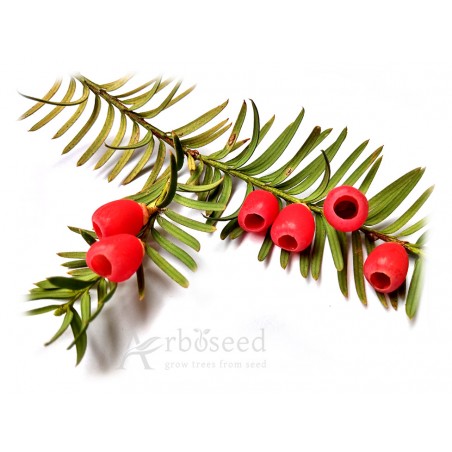

taxus baccata
taxus baccata
 Delivery
Usually 4 business days in EU by courier (DPD, GLS).
 Payment
PayPal or bank transfer
| 10 g | approx 151 seeds |
| 50 g | approx 757 seeds |
| 100 g | approx 1.515 seeds |
| 1.000 seeds | approx 66 g |
Common yew also known as English yew or European yew (botanical name: taxus baccata) - seeds
Data sheet
Taxus baccata (English yew / European yew) has a deep and complex seed dormancy. For reliable germination, a two-stage moist stratification process — warm followed by cold stratification — is recommended.
Germination is naturally slow and irregular. Some seeds may remain dormant for many months and may germinate only during a subsequent growing season.
If the seeds have been collected from fresh yew berries, carefully remove all remaining fleshy material (the red aril) and wash the seeds thoroughly.
If the seeds are already cleaned, they can be prepared directly for stratification.
Do not scarify, cut or mechanically damage the seeds.
Before stratification:
Place the seeds in a clean container.
Cover them with room-temperature water.
Soak for approximately 24 hours.
Drain the water and begin stratification.
The first stage is warm, moist stratification.
Mix the seeds with a slightly moist medium such as:
vermiculite,
perlite,
or clean horticultural sand.
Place the seeds and medium in a sealed plastic bag or closed container.
Keep at approximately 20–25°C (68–77°F).
Continue for approximately 3–6 months.
Check the seeds regularly for moisture and signs of mould.
The medium should remain moist but never waterlogged.
The warm period is important because it helps overcome part of the seed's physiological dormancy.
After the warm stratification period:
Move the seeds to approximately 2–5°C (36–41°F).
Continue moist stratification for another 3–6 months.
Check the seeds regularly to ensure that the medium remains slightly moist.
If a seed begins to germinate during stratification, carefully sow it into a suitable growing medium without damaging the emerging root.
After completion of the cold stratification period, sow the seeds as soon as possible.
Prepare a light, well-drained and well-aerated seed-starting medium.
Sow the seeds approximately 1–2 cm (0.4–0.8 in) deep.
Cover gently with the growing medium.
Water moderately.
Place the container in a bright location.
| Parameter | Recommended conditions |
|---|---|
| Warm stratification | 20–25°C (68–77°F) for 3–6 months |
| Cold stratification | 2–5°C (36–41°F) for 3–6 months |
| Temperature after sowing | 15–20°C (59–68°F) |
| Sowing depth | 1–2 cm (0.4–0.8 in) |
| Light | Bright light |
| Moisture | Keep the medium evenly moist |
After sowing, maintain consistent moisture. Avoid both complete drying and prolonged waterlogging.
Taxus baccata germination is naturally slow and often highly irregular.
Some seedlings may emerge a few weeks after the completion of stratification, but other seeds may remain dormant for considerably longer.
Germination may extend over 12 months or longer.
For this reason, do not discard the seed tray after several weeks or even several months without germination.
For growers who prefer not to perform many months of controlled stratification, autumn outdoor sowing is an excellent alternative.
Seeds sown outdoors in autumn can experience a natural sequence of temperatures:
autumn → warm period → winter → cold period → spring.
This naturally reproduces the seasonal conditions used in artificial stratification.
Protect the seed containers from excessive drying and from rodents or other animals that may eat the seeds.
Emergence may occur in the following spring or later.
After emergence:
provide a bright growing position,
maintain moderate and consistent moisture,
ensure good air circulation,
avoid overwatering,
protect young seedlings from intense direct sunlight during the earliest stages.
Once the seedlings are sufficiently developed and have established root systems, they can be carefully transplanted into individual pots.
Young seedlings do not require heavy feeding.
Approximately 4–6 weeks after emergence, once the plants are well established, begin light fertilization using a balanced fertilizer at approximately 1/4 of the manufacturer's recommended dosage.
Using only a short period of cold stratification.
Making the warm stratification period too short.
Allowing seeds to dry out during stratification.
Keeping seeds in excessively wet conditions.
Assuming that seeds are non-viable too early.
Discarding the seed tray after several months without emergence.
Sowing too deeply.
Over-fertilizing young seedlings.
Taxus baccata has deep and complex seed dormancy.
A warm stratification period followed by cold stratification is recommended.
The complete pre-sowing treatment may take approximately 6–12 months.
Germination may extend over 12 months or longer.
Do not allow the seeds to dry out during stratification.
Do not freeze the seeds.
Autumn outdoor sowing is a practical alternative to artificial stratification.
Soak the seeds for approximately 24 hours in room-temperature water, then mix them with slightly moist vermiculite, perlite or clean horticultural sand.
Use the following sequence:
3–6 months at 20–25°C (68–77°F) → followed by 3–6 months at 2–5°C (36–41°F).
After stratification, sow the seeds 1–2 cm (0.4–0.8 in) deep, maintain approximately 15–20°C (59–68°F) and keep the growing medium evenly moist and well drained.
Important: patience is essential. Yew seeds can germinate very slowly and irregularly.
Taxus baccata is highly toxic. Most parts of the plant, including the seeds, contain toxic compounds. Do not ingest the seeds and keep them away from children and pets. Use appropriate care when handling the seeds.
Taxus baccata