
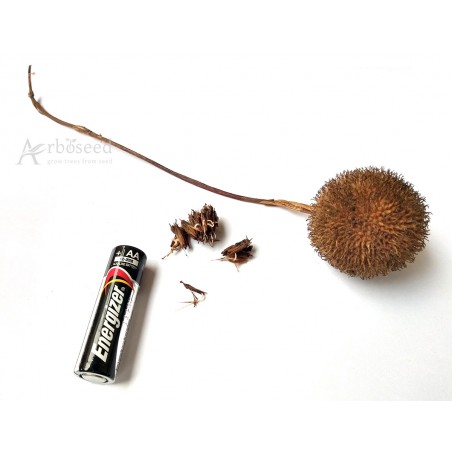


platanus acerifolia
platanus acerifolia
 Delivery
Usually 4 business days in EU by courier (DPD, GLS).
 Payment
PayPal or bank transfer
| 10 g | approx 2.000 seeds |
| 50 g | approx 10.000 seeds |
| 100 g | approx 20.000 seeds |
| 1.000 seeds | approx 5 g |
London plane also known as London planetree or hybrid plane (botanical name: platanus acerifolia, platanus hispanica) - seeds
Data sheet
Species: Platanus × acerifolia
Synonym: Platanus × hispanica
Common name: London Plane / Hybrid Plane
Seeds of Platanus × acerifolia are relatively easy to germinate. For fresh, properly stored seeds, long cold stratification is usually not necessary. A short period of moist cold stratification may nevertheless be used to improve germination uniformity.
Before sowing, the seeds may optionally be soaked:
Place the seeds in room-temperature water.
Soak for approximately 12–24 hours.
Drain the seeds gently after soaking.
Soaking is not essential, but it can help hydrate the seeds evenly.
Do not use boiling water or aggressive scarification, as the seeds are small and can easily be damaged.
Fresh seeds can normally be sown directly without stratification.
For older seeds, or when more uniform germination is desired, a short period of moist cold stratification can be used:
Mix the seeds with slightly moist vermiculite, perlite, or clean horticultural sand.
Place the mixture in a sealed bag or container.
Keep it in a refrigerator at approximately 2–5°C (36–41°F).
Stratify for approximately 2–4 weeks.
Check the seeds regularly for moisture and mould.
The medium should be slightly moist, but not wet or waterlogged.
Do not freeze the seeds.
After soaking or completing optional stratification, sow the seeds.
London Plane seeds are very small, and access to light is beneficial for germination.
Prepare a light, well-drained and well-aerated seed-starting medium.
Distribute the seeds evenly over the surface.
Do not cover the seeds with a thick layer of growing medium.
Gently press the seeds into the surface.
Moisten using a fine spray.
A very thin layer of fine vermiculite may be used if desired, but the seeds should not be buried deeply.
A suitable seed-starting mix can consist of approximately:
70–80% peat or coconut coir
20–30% perlite
The medium should be:
light;
well drained;
well aerated;
free of weeds;
capable of retaining moderate moisture.
Good drainage is essential.
| Parameter | Recommended conditions |
|---|---|
| Soaking | 12–24 hours – optional |
| Cold stratification | Not usually required; optionally 2–4 weeks |
| Stratification temperature | 2–5°C (36–41°F) |
| Germination temperature | approximately 18–22°C (64–72°F) |
| Sowing depth | Surface sowing / maximum approx. 0.2 cm (0.08 in) |
| Light | Bright location |
| Moisture | Keep the medium consistently slightly moist |
| Ventilation | Good air circulation |
After sowing, provide plenty of light and maintain consistent moisture.
Do not allow the surface of the growing medium to dry out, as this can quickly dry the germinating seeds and young roots.
At the same time, avoid excessive watering.
Under suitable conditions, the first seedlings may appear approximately 1–3 weeks after sowing.
Germination can be uneven, so do not discard ungerminated seeds too early.
After emergence:
provide a very bright location;
maintain moderate moisture;
ensure good air circulation;
avoid overwatering;
protect young seedlings from excessive heat.
Once the seedlings have developed several true leaves and are well rooted, they can be carefully transplanted into individual containers.
Take particular care not to damage the delicate roots during transplanting.
Fertilization is not necessary immediately after emergence.
Approximately 4–6 weeks after emergence, once the seedlings are well established, begin light feeding with a balanced fertilizer at approximately ¼ of the manufacturer's recommended dosage.
The seeds can also be sown outdoors in autumn, for example in containers or a protected seed bed.
Natural autumn and winter conditions may provide an appropriate period of cold exposure.
When using outdoor sowing, protect the containers from:
excessive moisture;
drying out;
birds;
rodents.
Germination may begin naturally in spring as temperatures rise.
Sowing too deeply.
Covering the small seeds with a thick layer of growing medium.
Insufficient light.
Allowing the surface of the medium to dry out.
Overwatering.
Using heavy, poorly drained soil.
Excessively high temperatures.
Fertilizing too early.
Damaging the delicate roots during transplanting.
Platanus × acerifolia is relatively easy to propagate from seed.
Long cold stratification is usually not necessary.
Fresh seeds can generally be sown directly.
Optional stratification for 2–4 weeks at 2–5°C (36–41°F) may help improve germination uniformity.
Seeds should be sown very shallowly, preferably on the surface.
Access to light is beneficial for germination.
A germination temperature of approximately 18–22°C (64–72°F) is recommended.
The first seedlings usually appear within approximately 1–3 weeks.
The growing medium should remain consistently slightly moist, but never waterlogged.
Fresh, properly stored seeds generally provide the best results.
1. Optionally soak the seeds for 12–24 hours in room-temperature water.
2. Fresh seeds can be sown without stratification. For older seeds, use 2–4 weeks of moist cold stratification at 2–5°C (36–41°F).
3. Sow the seeds on the surface of a light, well-drained growing medium.
4. Gently press the seeds into the medium and moisten with a fine spray. Do not cover with a thick layer of soil.
5. Maintain approximately 18–22°C (64–72°F), provide a bright location and keep the growing medium consistently slightly moist.
The first seedlings will usually appear within approximately 1–3 weeks after sowing.

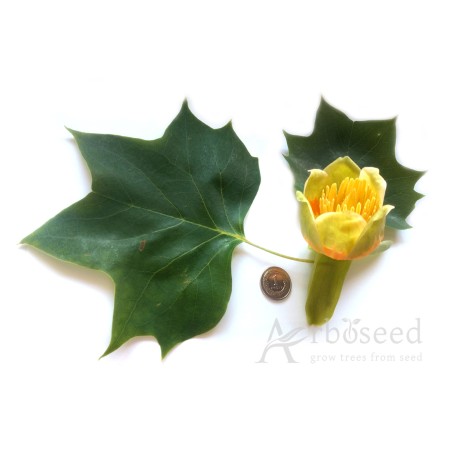

 Platanus acerifolia