
pyrus pyraster
pyrus pyraster
 Delivery
Usually 4 business days in EU by courier (DPD, GLS).
 Payment
PayPal or bank transfer
| 10 g | approx 334 seeds |
| 50 g | approx 1.667 seeds |
| 100 g | approx 3.333 seeds |
| 1.000 seeds | approx 30 g |
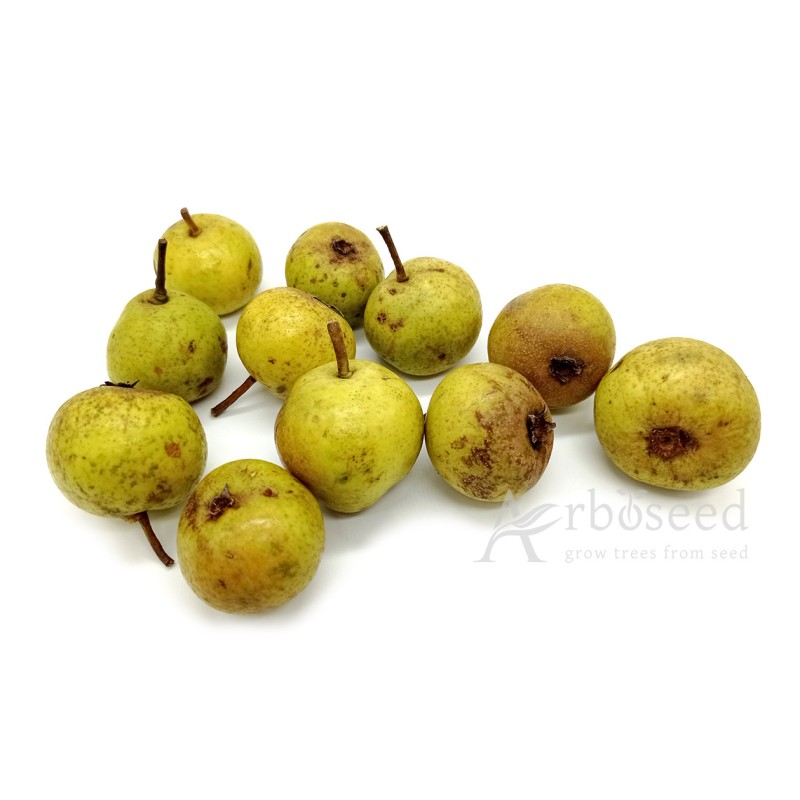
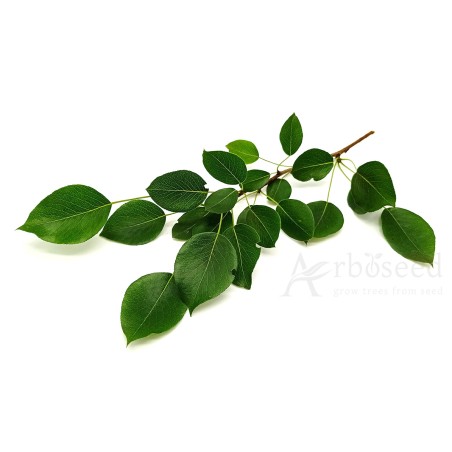
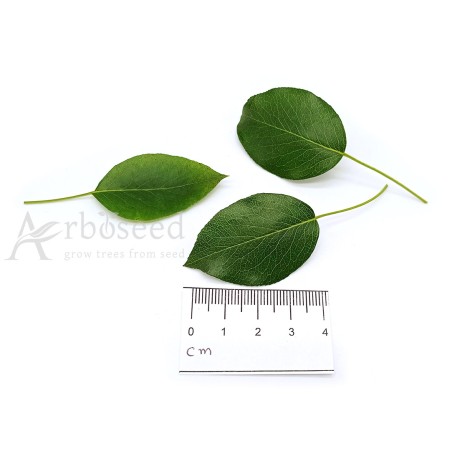
European wild pear (botanical name: pyrus pyraster, syn. pyrus communis subsp. pyraster) - seeds
Data sheet
Pyrus pyraster (European wild pear) produces seeds with physiological dormancy. To achieve reliable and more uniform germination, the seeds benefit from moist cold stratification before sowing.
Mechanical scarification is normally not required.
If the seeds have been collected from fresh fruit, carefully remove all remaining fruit pulp and rinse the seeds thoroughly.
If the seeds are already cleaned and dry, they can be prepared directly for stratification.
Do not cut, nick or mechanically damage the seeds.
Before cold stratification:
Place the seeds in a clean container.
Cover them with room-temperature water.
Soak for approximately 12–24 hours.
Drain the water and proceed with stratification.
Soaking helps fully hydrate the seeds and supports the processes required to overcome dormancy.
The most practical method for home propagation is cold stratification in a refrigerator.
Mix the seeds with a slightly moist medium such as:
vermiculite,
perlite,
or clean horticultural sand.
The medium should be moist but not wet.
Place the seeds and medium in a sealed plastic bag or closed container.
Keep at approximately 2–5°C (36–41°F) in a refrigerator.
Stratify for approximately 8–12 weeks.
Check the seeds every 1–2 weeks to ensure that the medium remains slightly moist and to monitor the seeds for mould.
If a seed begins to germinate during stratification, carefully sow it into the growing medium. Take particular care not to damage the emerging root.
After completion of stratification, sow the seeds as soon as possible.
Prepare a light, well-drained seed-starting medium.
Sow the seeds approximately 1–2 cm (0.4–0.8 in) deep.
Cover gently with the growing medium.
Water moderately.
Place the container in a bright location.
| Parameter | Recommended conditions |
|---|---|
| Stratification temperature | 2–5°C (36–41°F) |
| Stratification period | 8–12 weeks |
| Temperature after sowing | 15–20°C (59–68°F) |
| Light | Bright light |
| Sowing depth | 1–2 cm (0.4–0.8 in) |
| Moisture | Keep the medium evenly moist |
After sowing, maintain consistent moisture. Do not allow the growing medium to dry out completely, but avoid prolonged waterlogging.
After successful stratification, the first seedlings may appear approximately 2–4 weeks after sowing.
Germination can be uneven, and some seeds may require additional time.
Do not discard the seed tray prematurely if some seeds have not germinated after several weeks.
After emergence:
provide plenty of light,
maintain moderate and consistent moisture,
ensure good air circulation,
avoid excessive watering.
Once seedlings have developed several true leaves and a well-established root system, they can be carefully transplanted into individual pots.
Young seedlings do not require heavy fertilization.
Approximately 3–4 weeks after emergence, once the plants are well established, begin light feeding with a balanced fertilizer at approximately 1/4 of the manufacturer's recommended dosage.
The dosage can gradually be increased as the plants develop.
Skipping cold stratification.
Sowing the seeds too deeply.
Allowing the seeds to dry out during stratification.
Keeping the seeds or growing medium excessively wet.
Using excessively high temperatures during germination.
Over-fertilizing young seedlings.
Moist cold stratification is recommended for reliable germination.
The recommended stratification period is approximately 8–12 weeks at 2–5°C (36–41°F).
Do not freeze the seeds.
During stratification, the seeds must remain moist but should never be submerged in water.
Germination may be uneven.
Fresh, properly stored seeds generally provide the best results.
Soak the seeds for 12–24 hours in room-temperature water. Mix them with slightly moist vermiculite, perlite or clean horticultural sand and place them in a refrigerator for 8–12 weeks at 2–5°C (36–41°F).
After stratification, sow the seeds 1–2 cm (0.4–0.8 in) deep and maintain a temperature of approximately 15–20°C (59–68°F), bright light and evenly moist, well-drained growing medium.
 European wild pear