
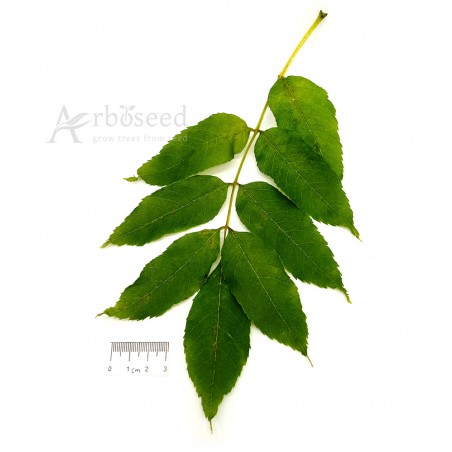

fraxinus excelsior
fraxinus excelsior
 Delivery
Usually 4 business days in EU by courier (DPD, GLS).
 Payment
PayPal or bank transfer
| 10 g | approx 143 seeds |
| 50 g | approx 714 seeds |
| 100 g | approx 1.428 seeds |
| 1.000 seeds | approx 70 g |
European ash also known as ash and common ash (botanical name: fraxinus excelsior) - seeds
Data sheet
Species: Fraxinus excelsior
Common name: European Ash
Seeds of Fraxinus excelsior have a deep morphophysiological dormancy. Successful germination therefore requires a relatively long period of preparation involving warm, moist stratification followed by cold, moist stratification.
A short period of cold stratification alone is generally insufficient.
Place the seeds in a moist stratification medium.
A suitable medium is a mixture of:
50% clean horticultural sand + 50% peat
Slightly moist vermiculite can also be used.
The medium should be moist but not wet or waterlogged.
Mix the seeds thoroughly with the medium and place them in a suitable container or bag that allows some air exchange.
The warm phase allows the underdeveloped embryo to complete its development.
Place the seeds in the moist stratification medium.
Maintain a temperature of approximately 15–20°C (59–68°F).
Continue warm stratification for approximately 12–16 weeks.
Check the seeds and moisture level regularly.
For some seed lots, a full 16-week warm period may provide better subsequent germination.
Do not allow the seeds to dry out during this stage.
After completing the warm phase, transfer the seeds to cold conditions.
Reduce the temperature to approximately 1–5°C (34–41°F).
Continue stratification for approximately 12–16 weeks.
Check the moisture level regularly.
Keep the medium moist but well aerated.
A practical protocol often used for Fraxinus excelsior is approximately:
16 weeks warm stratification at 15–20°C → 16 weeks cold stratification at approximately 0–3°C.
Do not freeze the seeds.
If a seed begins to germinate during the cold phase, carefully sow it immediately, taking care not to damage the emerging root.
Inspect the seeds periodically.
If mould develops:
remove affected seeds;
reduce excess moisture;
improve ventilation;
replace the stratification medium if necessary.
The seeds should remain moist throughout the entire process, but they must not be submerged in water.
After completing both stratification phases, sow the seeds as soon as possible.
Prepare a light, well-drained and well-aerated seed-starting medium.
Sow the seeds approximately 1–2 cm (0.4–0.8 in) deep.
Cover gently with the growing medium.
Moisten the medium evenly.
Place the container in a bright location.
A suitable growing medium is a quality seed-starting mix, for example peat or coconut coir with the addition of perlite.
Good drainage is essential.
| Parameter | Recommended conditions |
|---|---|
| Warm stratification | 12–16 weeks |
| Warm stratification temperature | 15–20°C (59–68°F) |
| Cold stratification | 12–16 weeks |
| Cold stratification temperature | 1–5°C (34–41°F) |
| Practical protocol | 16 weeks warm → 16 weeks cold |
| Post-stratification temperature | approximately 10–20°C (50–68°F) |
| Sowing depth | 1–2 cm (0.4–0.8 in) |
| Moisture | Keep the medium consistently slightly moist |
| Light | Bright location |
| Ventilation | Good air circulation |
After sowing, maintain moderate and consistent moisture.
Avoid excessive watering and waterlogging.
Temperatures significantly above approximately 20°C (68°F) are not recommended during germination, as high temperatures may inhibit germination or contribute to secondary dormancy.
After successful completion of both stratification phases, germination may begin relatively quickly after sowing.
However, germination can be uneven and extended over time.
Do not discard seeds that do not germinate immediately.
After emergence:
provide a bright location;
maintain moderate and consistent moisture;
ensure good air circulation;
avoid waterlogging;
protect young seedlings from excessive heat and intense direct sunlight immediately after emergence.
Once the seedlings have developed several true leaves and are well rooted, they can be carefully transplanted into individual containers.
Take care not to damage the young root system during transplanting.
Fertilization is not necessary immediately after emergence.
Approximately 4–6 weeks after emergence, once the seedlings are well established, begin light feeding with a balanced fertilizer at approximately ¼ of the manufacturer's recommended dosage.
Seeds can also be sown outdoors in autumn, either directly into the ground, in a seed bed, or in containers.
Natural seasonal temperature changes can provide the warm and subsequent cold periods required to overcome dormancy.
However, this method is less predictable in terms of germination timing and uniformity than controlled stratification.
When using outdoor sowing, protect the seeds from rodents, birds, excessive moisture and prolonged drying.
Using only cold stratification.
Skipping the warm stratification phase.
Using an unnecessarily short warm phase.
Allowing the seeds to dry out during stratification.
Keeping the seeds in waterlogged conditions.
Freezing the seeds.
Exposing the seeds to excessively high temperatures after stratification.
Sowing too deeply.
Overwatering after sowing.
Discarding ungerminated seeds too early.
Damaging the roots during transplanting.
Fraxinus excelsior has deep morphophysiological seed dormancy.
Successful germination generally requires warm followed by cold moist stratification.
A practical protocol is approximately 16 weeks at 15–20°C (59–68°F), followed by 16 weeks at approximately 0–3°C (32–37°F).
The complete preparation period may therefore take approximately 32 weeks.
Cold stratification alone is generally insufficient.
Seeds must remain moist throughout stratification but must not be waterlogged.
Sow the seeds as soon as possible after completing stratification.
A post-stratification temperature of approximately 10–20°C (50–68°F) is suitable.
Fresh, mature and properly stored seeds generally provide the best results.
1. Mix the seeds with a slightly moist 1:1 mixture of clean horticultural sand and peat.
2. Warm-stratify for approximately 16 weeks at 15–20°C (59–68°F).
3. Transfer the seeds to approximately 0–3°C (32–37°F) for another 16 weeks for cold stratification.
4. After completing both stages, sow the seeds approximately 1–2 cm (0.4–0.8 in) deep in a light, well-drained seed-starting medium.
5. Maintain approximately 10–20°C (50–68°F), provide a bright location and keep the growing medium consistently slightly moist.
6. Do not discard seeds that fail to germinate immediately, as germination may be uneven.
Note: The exact stratification requirements and germination time may vary between seed lots.


 Fraxinus excelsior