

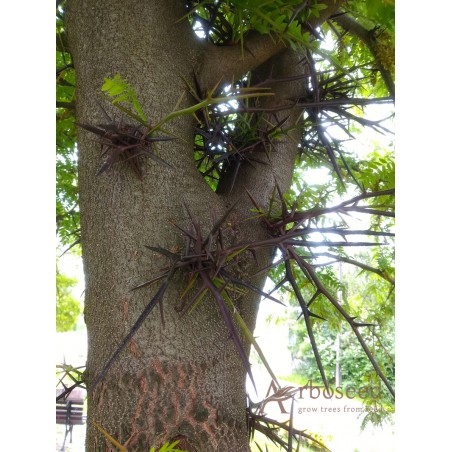

gleditsia triacanthos
gleditsia triacanthos
 Delivery
Usually 4 business days in EU by courier (DPD, GLS).
 Payment
PayPal or bank transfer
| 10 g | approx 38 seeds |
| 50 g | approx 192 seeds |
| 100 g | approx 385 seeds |
| 1.000 seeds | approx 260,00 g |
Honey locust also known as thorny locust or thorny honeylocust (botanical name: gleditsia triacanthos) - seeds
Data sheet
Common name: Honey Locust
Botanical name: Gleditsia triacanthos
Family: Fabaceae
Honey Locust seeds have a very hard, impermeable seed coat, which can prevent water from entering the seed and significantly delay germination.
For this reason, scarification is strongly recommended before sowing.
For a small quantity of seeds, mechanical scarification is a simple and safe method:
Gently rub one side of each seed with medium- or fine-grit sandpaper or a small file.
Remove only a small section of the outer seed coat until a lighter-coloured layer becomes visible.
Do not damage the embryo inside the seed.
After scarification, soak the seeds in lukewarm water for 12–24 hours.
Seeds that have visibly swollen should be sown immediately after soaking.
The purpose of scarification is to create a small opening in the hard seed coat, allowing water to penetrate the seed.
An alternative method is hot-water scarification:
Bring water to a boil.
Remove it from the heat and allow it to cool for approximately one minute.
Pour the hot water over the seeds.
Leave the seeds in the water until it cools to room temperature.
Continue soaking for approximately 12–24 hours.
Sow the seeds immediately after they have swollen.
For home cultivation, mechanical scarification is generally easier to control.
Do not use concentrated acids for seed treatment at home.
Cold stratification is generally not required for Gleditsia triacanthos.
The main obstacle to germination is the physical dormancy caused by the hard seed coat. Once the seed coat has been properly scarified and the seed has absorbed water, the seeds can normally be sown directly.
Use a light, well-drained and sterile growing medium.
A suitable mixture is:
50–70% peat or coco coir
30–50% perlite or coarse sand
Sow the seeds approximately 0.5–1.5 cm (0.2–0.6 in) deep.
After sowing, gently water the substrate. Make sure the container has adequate drainage holes.
Maintain the following conditions:
Temperature: approximately 20–25°C (68–77°F)
Light: bright location; provide plenty of light after emergence
Moisture: keep the substrate evenly and lightly moist
Drainage: excellent drainage is essential
Do not allow the substrate to dry out completely, but avoid constantly wet conditions. Excessive moisture can lead to seed rot and fungal problems.
After successful scarification, germination can be relatively rapid.
Under favourable conditions, the first seedlings may appear within approximately 1–3 weeks.
Germination may continue for several weeks because individual seeds can differ in dormancy and viability.
After emergence:
Provide plenty of light.
Water moderately and allow excess water to drain freely.
Avoid permanently saturated soil.
Provide good air circulation.
Protect young seedlings from severe heat and excessive drying.
Honey Locust develops a strong root system with a prominent main root, so young plants should be transplanted carefully and preferably before the main root becomes severely restricted by a small container.
For this reason, relatively deep containers are preferable to very shallow ones.
Fertilization is not necessary immediately after germination.
Approximately 4–6 weeks after emergence, once the seedlings are well established, begin feeding with a balanced, water-soluble fertilizer.
Use approximately ¼ of the manufacturer's recommended concentration for the first applications.
Avoid excessive fertilization, particularly excessive nitrogen, during the early stages of growth.
Seeds can also be sown outdoors in autumn.
Natural environmental conditions during autumn and winter can help overcome seed dormancy and allow germination to occur naturally in spring.
However, for controlled cultivation, scarification before sowing is recommended because it generally provides more predictable and uniform results.
Outdoor containers should be protected from rodents and birds, which may remove or damage the seeds.
The hard seed coat is the main barrier to germination.
Scarification is the most important preparation step.
Cold stratification is generally unnecessary.
Mechanical scarification is particularly suitable for small quantities of seeds.
After scarification, soaking for 12–24 hours helps the seed absorb water.
Do not combine several aggressive scarification methods on the same seeds.
Keep the substrate moist but never waterlogged.
Honey Locust develops a vigorous root system, so young seedlings benefit from sufficiently deep containers.
Germination speed and percentage may vary depending on seed freshness, storage conditions and seed-lot quality.
Scarify one side of the seed with sandpaper → soak for 12–24 hours → sow 0.5–1.5 cm deep → maintain 20–25°C → provide bright light → keep the substrate lightly moist and well drained → expect germination within approximately 1–3 weeks.
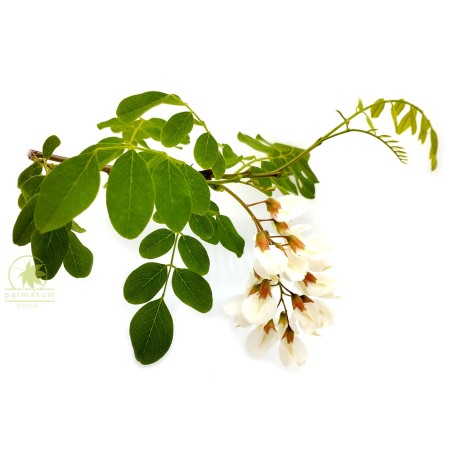
 Gleditsia triacanthos