- out-of-Stock

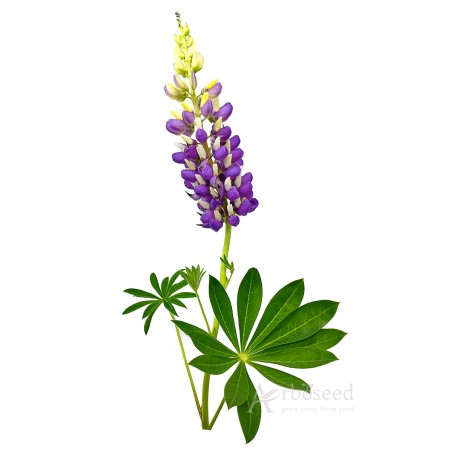


lupinus polyphyllus
lupinus polyphyllus
 Delivery
Usually 4 business days in EU by DPD courier.
 Payment
PayPal or bank transfer
| 10 g | approx 222 seeds |
| 50 g | approx 1.111 seeds |
| 100 g | approx 2.222 seeds |
| 1.000 seeds | approx 45 g |
Large-leaved lupine also known as big-leaved lupine, many-leaved lupine, blue-pod lupine (botanical name: lupinus polyphyllus) - seeds
A species classified as invasive in Poland and listed as an Invasive Alien Species by the General Directorate for Environmental Protection. Sow with caution and in a controlled environment.
Data sheet
Species: Lupinus polyphyllus
Common name: Bigleaf Lupine / Garden Lupine
Seeds of Lupinus polyphyllus have a hard, water-impermeable seed coat, which can significantly slow down water uptake and germination. Scarification is therefore recommended before sowing.
Gently scarify each seed by rubbing a small area of the seed coat with fine sandpaper or a small file.
The purpose is only to slightly break or thin the outer seed coat and allow water to penetrate.
Take care not to damage the embryo inside the seed.
Instead of mechanical scarification, a hot-water treatment can be used:
Place the seeds in a heat-resistant container.
Pour hot water at approximately 80–90°C (176–194°F) over the seeds.
Allow the water to cool naturally and leave the seeds to soak for approximately 12–24 hours.
Seeds that have swollen noticeably can then be sown.
Mechanical scarification is generally the more predictable method for small quantities of seeds.
After mechanical scarification:
Place the seeds in room-temperature water.
Soak for approximately 12–24 hours.
Sow the seeds as soon as possible after soaking.
The seeds should noticeably increase in size as they absorb water.
Cold stratification is generally not necessary for Lupinus polyphyllus when the seeds have been properly scarified and hydrated.
For this species, scarification + soaking + sowing at a suitable temperature is a simple and reliable approach.
After scarification and soaking:
Prepare a light, well-drained and well-aerated seed-starting medium.
Sow the seeds approximately 1–2 cm (0.4–0.8 in) deep.
Cover gently with the growing medium.
Water moderately.
Place the container in a bright location.
A suitable medium is a quality seed-starting mix, for example peat or coconut coir with the addition of perlite.
Good drainage is essential.
| Parameter | Recommended conditions |
|---|---|
| Scarification | Recommended |
| Soaking | 12–24 hours |
| Cold stratification | Usually not required |
| Germination temperature | approximately 18–22°C (64–72°F) |
| Sowing depth | 1–2 cm (0.4–0.8 in) |
| Light | Bright location |
| Moisture | Keep the medium lightly and evenly moist |
| Ventilation | Good air circulation |
After sowing, maintain consistent moisture. Do not allow the medium to become waterlogged.
After proper scarification and soaking, the first seedlings may appear approximately 7–21 days after sowing.
Germination can be uneven, so keep the seeds under suitable conditions for several additional weeks.
After emergence:
provide a bright location;
maintain moderate moisture;
ensure good air circulation;
avoid overwatering;
protect very young seedlings from intense direct sunlight immediately after emergence.
Lupinus polyphyllus develops a relatively strong root system. Avoid keeping young plants in very small containers for too long.
Transplant while the plants are still young and well rooted, disturbing the root system as little as possible.
Fertilization is not necessary immediately after emergence.
Approximately 4–6 weeks after emergence, once the seedlings are well established, begin light feeding with a balanced fertilizer at approximately ¼ of the manufacturer's recommended dosage.
The seeds can also be sown outdoors in autumn, directly into the ground or into containers.
Natural autumn and winter conditions may help overcome seed dormancy. However, scarification is still recommended because the hard seed coat is the main physical barrier to water uptake.
When sowing outdoors, protect the seeds from rodents and birds.
Skipping scarification when the seed coat is very hard.
Scarifying too aggressively and damaging the embryo.
Soaking for excessively long periods.
Sowing too deeply.
Overwatering.
Using heavy, poorly drained soil.
Keeping young plants in very small containers for too long.
Fertilizing seedlings too early.
Lupinus polyphyllus seeds have a hard, water-impermeable seed coat that can restrict water uptake.
Mechanical scarification is recommended to improve and accelerate germination.
After scarification, soaking for 12–24 hours is recommended.
Cold stratification is generally not required.
A germination temperature of approximately 18–22°C (64–72°F) is suitable.
Sow the seeds approximately 1–2 cm (0.4–0.8 in) deep.
The first seedlings usually appear within approximately 7–21 days.
The growing medium should be well drained and moderately moist.
Excessive moisture can cause seed and seedling rot.
1. Gently scarify a small area of each seed coat using fine sandpaper or a file.
2. Soak the seeds for 12–24 hours in room-temperature water.
3. Sow the swollen seeds approximately 1–2 cm (0.4–0.8 in) deep in a light, well-drained growing medium.
4. Maintain approximately 18–22°C (64–72°F), provide a bright location and keep the growing medium consistently slightly moist.
5. Avoid both waterlogging and prolonged drying of the growing medium.
The first seedlings will usually appear within approximately 7–21 days.
Large-leaved lupine