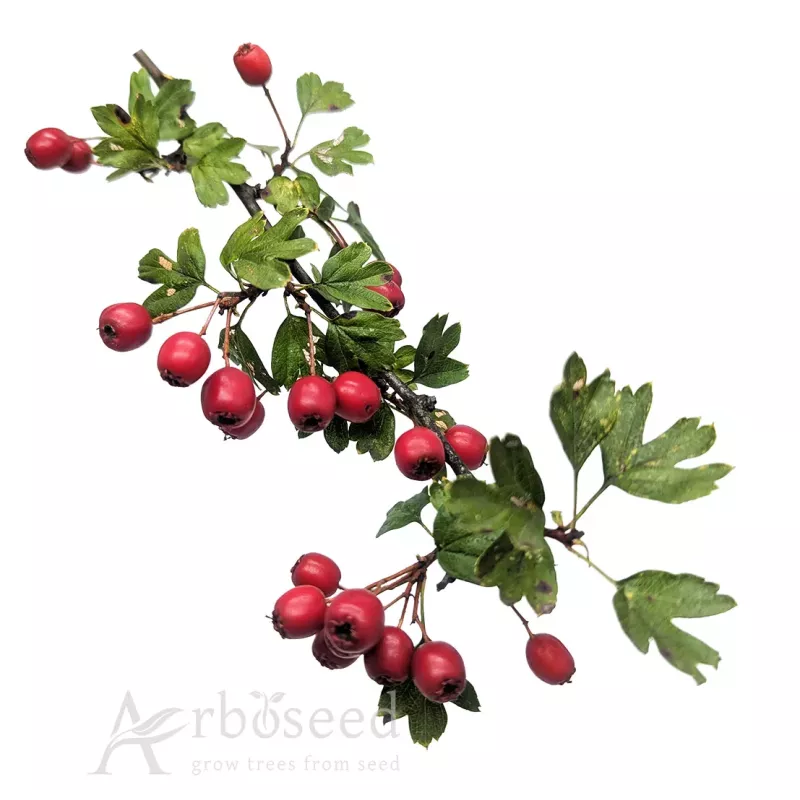


crataegus monogyna
crataegus monogyna
 Delivery
Usually 4 business days in EU by courier (DPD, GLS).
 Payment
PayPal or bank transfer
| 10 g | approx 152 seeds |
| 50 g | approx 758 seeds |
| 100 g | approx 1.515 seeds |
| 1.000 seeds | approx 66 g |
Common hawthorn also known as one-seed hawthorn, or single-seeded hawthorn (botanical name: crataegus monogyna) - seeds
Data sheet
Recommended method: warm stratification followed by cold stratification
Common hawthorn seeds have deep dormancy, which means that they often require an extended period of pretreatment before they will germinate. A combination of warm and cold stratification is recommended. Germination can be slow and uneven, so patience is essential.
If the seeds are collected from fresh fruits, remove all the fruit flesh and clean the hard seed stones thoroughly.
Before stratification, soak the stones in clean, room-temperature water for approximately 24 hours.
Do not crack the stones or damage their hard outer covering. Do not use acids or other aggressive chemicals to treat the seeds.
Mix the stones with a slightly moist medium, such as clean sand, vermiculite, or a mixture of sand and peat.
Temperature: approximately 20–25°C (68–77°F)
Duration: approximately 16 weeks
Moisture: keep the medium consistently slightly moist, but never waterlogged
Place the mixture in a container or plastic bag that helps retain moisture. Ensure there is some air exchange and inspect the seeds regularly.
After completing the warm phase, transfer the stones and moist medium to a refrigerator.
Temperature: approximately 2–5°C (36–41°F)
Duration: approximately 15–18 weeks
Moisture: maintain slightly moist conditions and avoid excess water
Check the seeds regularly for mould and signs of germination. If any seeds begin to germinate, carefully plant them in individual containers without damaging the emerging roots.
Important: The exact pretreatment required may vary between seed lots. Even with appropriate stratification, not all seeds will germinate at the same time.
After stratification, sow the stones in pots, seed trays, or directly outdoors when weather conditions are suitable.
Recommended sowing depth: approximately 1–2 cm (⅜–¾ inch).
Use a well-draining growing medium, such as seed-starting compost mixed with perlite or sand. Water gently after sowing.
If any seeds have already germinated during stratification, handle them with particular care to avoid damaging the young roots.
After sowing, provide the following conditions:
Temperature: approximately 10–20°C (50–68°F)
Light: a bright location with good light for emerging seedlings
Moisture: keep the substrate evenly moist, but never waterlogged
Ventilation: ensure good air circulation to reduce the risk of mould
The first seedlings may emerge approximately 3–6 weeks after the completion of stratification, but some seeds may take considerably longer. A lack of rapid germination does not necessarily mean that the seeds are no longer viable.
Once seedlings emerge, maintain moderate soil moisture and provide plenty of light.
When the seedlings are large enough to handle safely, transplant them into individual containers. Take care not to damage their roots.
Common hawthorn is a hardy species, but young plants should be gradually acclimatized to outdoor conditions before being left outside permanently.
Do not fertilize the seeds or newly emerged seedlings.
Begin feeding approximately 4–6 weeks after emergence, using a balanced, water-soluble fertilizer at around one-quarter of the manufacturer's recommended strength.
As the plants develop, the fertilizer concentration can be adjusted gradually according to their growth and condition.
Common hawthorn has deep seed dormancy and requires patience.
Both warm and cold stratification phases must be carried out under appropriately moist conditions.
Do not allow the seeds to dry out during stratification.
Avoid excessive moisture, which can cause the stones to rot.
Germination may be spread over an extended period, and some seeds may require additional time before emerging.
Do not discard ungerminated seeds too early.
Clean the seed stones → soak for 24 hours → warm-stratify for approximately 16 weeks at 20–25°C → cold-stratify for 15–18 weeks at 2–5°C → sow 1–2 cm deep → maintain moderate moisture at approximately 10–20°C → allow sufficient time for germination.
With suitable pretreatment and patient care, Crataegus monogyna can be successfully grown from seed.
Crataegus monogyna